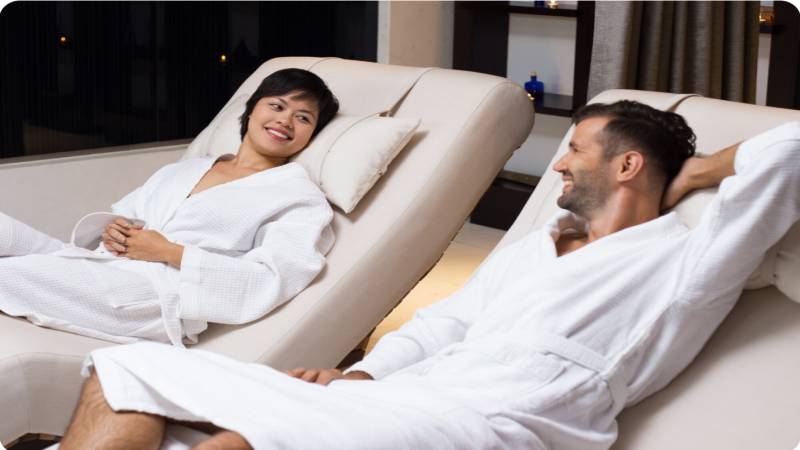
Something interesting is happening in the home wellness market. Large 2 person infrared sauna home units are consistently among the fastest-moving products in the premium recovery category – not because they are the most affordable option, but because couples and families who buy them report using them more consistently, more often, and for longer than people who buy solo units. The social dimension of shared recovery is not a minor factor. For many households, it is the difference between a recovery tool that gets daily use and one that becomes an expensive coat rack.
Recovery habits are easier to maintain when they are shared. If your partner, training partner, or family member joins you in a sauna session, the ritual becomes social as well as physiological. You are less likely to skip a session when it is built into a shared routine. You are more likely to extend the session duration when conversation or quiet companionship makes the time pass more naturally. These behavioral factors compound over months into meaningfully higher session frequency – and frequency is what drives long-term recovery results.
Why Couples Are Leading the Two-Person Sauna Market
The surge in couples purchasing two-person infrared saunas reflects a broader shift toward shared wellness investment. Rather than individual memberships, individual equipment, and separate recovery routines, more couples are choosing to build a shared home wellness environment that serves both partners – and the two-person infrared sauna is the centerpiece of that choice in most cases. The nightly 20 to 30 minute sauna session has become, for many couples, a technology-free decompression ritual that replaces or supplements other end-of-day habits.
The physiological benefits are identical regardless of whether you use the sauna alone or with a partner – improved sleep quality, reduced muscle tension, nervous system downregulation, and the cardiovascular conditioning benefits of regular heat therapy. What changes with shared sessions is the behavioral consistency that makes those benefits accumulate. A couple who sauna together four nights a week will outperform, physiologically, a solo user who manages two or three sessions per week in the same unit over a six-month period.
What Makes a Sauna Genuinely Comfortable for Two
Not all saunas marketed as two-person units deliver a genuinely comfortable shared experience. Some two-person units provide enough bench space for two people seated shoulder to shoulder without significant room for comfortable positioning variation. A genuinely comfortable two-person sauna provides enough bench length and cabin width for two adults to sit with comfortable space between them, shift positions during the session, and enter and exit without physical awkwardness.
Interior bench configuration matters as well. L-shaped bench layouts allow one user to sit upright while another lies with legs extended – a configuration that works well for couples with different recovery preferences or different session duration targets. Benches at multiple height levels allow users to choose different infrared intensity levels based on how close they are to the panel coverage. These design details distinguish a sauna designed thoughtfully for shared use from one simply sized to fit two people.
Family Use Cases That Go Beyond Recovery
For families with athletes at multiple stages of training and development, a two-person infrared sauna supports post-activity recovery for multiple household members without scheduling conflicts. Parents who train alongside their older children, households where multiple family members compete in different sports, or simply families where more than one person values heat therapy as part of their wellness routine all benefit from the capacity and flexibility that a large two-person unit provides.
Beyond athletics, families increasingly use shared sauna sessions as a screen-free social ritual – a dedicated period of conversation, quiet connection, or simple relaxation that the pace of modern family life often crowds out. The health benefits of the session are a bonus to what many families report as the most consistently maintained quality time in their weekly schedule. That behavioral value is not something any single-person unit can deliver, regardless of its panel quality.
Heat Distribution in a Larger Two-Person Cabin
The quality of the infrared heat experience in a two-person sauna depends heavily on panel placement and coverage across the larger cabin volume. A well-engineered two-person unit positions panels to deliver consistent infrared coverage across the full bench area, not just near the primary panel locations. Both users should receive equivalent heat exposure regardless of where they are seated in the cabin – achieving this requires more total panel coverage and more careful placement than a single-person unit requires.
When evaluating a two-person sauna, ask the manufacturer for the panel placement diagram and total wattage across the cabin. Compare this to the interior dimensions to get a sense of panel density. Quality brands engineer their two-person and larger units with sufficient panel coverage to maintain the heat and infrared intensity that makes sessions effective for both occupants, not just the user sitting closest to the primary heating element.
The Financial Case for a Shared Home Sauna Investment
When a two-person infrared sauna serves two regular users, the per-person cost of the investment drops dramatically. A four-thousand-dollar unit used four times per week by two people over three years works out to approximately one dollar and sixty cents per person per session – before accounting for the ongoing cost savings from reduced spa, gym, and recovery service expenses. The financial argument for a shared home sauna investment becomes even clearer when you calculate it on a per-person basis rather than as a total unit cost.
The key financial variable is utilization. A two-person sauna that sees seven to ten sessions per week across both users consistently outperforms the per-session economics of a single-person unit used three to five times weekly. Couples and families who genuinely commit to the shared recovery routine find that the investment reaches clear financial parity with spa memberships or equivalent services within one to two years of consistent use – after which every session is pure return on an asset you already own.
Making the Shared Sauna Routine Work Practically
The practical success of a shared sauna routine comes down to scheduling and setup. Smart sauna units with app-controlled preheat make it easy to have the unit ready at a consistent time each day without either partner managing the manual setup. Establishing a regular sauna time – post-dinner, pre-sleep, or as part of a post-training routine that both users follow – removes the decision overhead from the daily habit and makes it as automatic as brushing your teeth before bed.
Keep the sauna environment simple and welcoming. Good bench towels, hydration accessible near the unit, and a consistent audio or quiet protocol make the shared session feel like a genuine ritual rather than a chore. The couples and families who sustain the highest session frequency consistently report that the environmental ritual – not just the physiological benefits – is what keeps them returning to the sauna night after night without the motivation management that solo habits often require.
For couples and families ready to build a shared recovery ritual around a premium home sauna, Dialed Labs offers large-capacity two-person and king-size infrared saunas engineered for consistent heat distribution, durable shared use, and the long-term quality that makes a household wellness investment genuinely worth making.
Frequently Asked Questions
Can two people with different heat tolerance levels comfortably share an infrared sauna session?
Yes – in a well-designed two-person unit, users can position themselves at different heights on multi-level benches to experience different infrared intensities within the same session. The user on the lower bench or farther from primary panels experiences a milder heat stimulus, while the upper bench position closer to panels delivers greater intensity. This flexibility makes shared sessions workable even for users with meaningfully different heat tolerance levels.
Is a large two-person sauna significantly more expensive to run than a solo unit?
A two-person infrared sauna draws more power than a solo unit due to the greater panel coverage required to heat the larger cabin volume. In practice, the difference in monthly electricity costs between a one-person and a two-person unit of equivalent panel quality is typically 15 to 30 dollars per month depending on local utility rates and usage frequency. When used by two people, the per-person operating cost is comparable to or lower than a solo unit used at the same frequency by one person.
How do I know if a two-person sauna will genuinely be comfortable for both users?
Request the specific interior dimensions – width, depth, and bench length – before purchasing, and compare them against both users’ body dimensions. A genuinely comfortable two-person sauna should provide at least 24 inches of bench width per user with additional space between occupants. L-shaped bench configurations or multi-level benches significantly improve the flexibility of the shared session experience compared to a straight single-bench layout.
How long should a shared sauna session last for recovery purposes?
Most couples and family users find 20 to 35 minute sessions the most sustainable for regular shared use, balancing meaningful physiological benefits with a time commitment that fits naturally into an evening routine. Longer sessions of 40 to 45 minutes are common for experienced users with established heat tolerance. The ideal duration depends on temperature, individual heat tolerance, and whether the session is standalone or part of a broader contrast therapy protocol.
What is the best time of day for a shared sauna session?
Most couples find the post-dinner, pre-sleep window of 7 to 9 PM most practical for shared sauna sessions, as it aligns with a natural wind-down period and supports the parasympathetic nervous system activation that improves sleep quality. Post-training sessions work well for households where both partners train in the evening. Morning sauna sessions are less common for shared use but are practical for households with flexible schedules where both users are available earlier in the day.See More